

If there is a illogical statement existing and the negation of that statement is also existing. If probability of first statement to be to be true/false is not determined, then probability of negation of that statement is also not determined.
A=Any Statement
B=~A= Opposite of statement above.
if p(A)=x then
p(B)=p(~A) may or may not be equal to 1-x
A statement that can’t be assigned by boolean values is called as illogical statement that is, if a statement has multiple true or false values we call it a illogical statement
The examples of a illogical statements are used by many people in a very wrong way.
For Example:
If we consider the statement
A=Earth is spherical in shape
and
The negation of this statement as
B=(~A)= Earth is not spherical in shape.
Now this statement when we analyze we come to know that both the statements are partially true. Now the reasoning why both the statements are partially true is because
1) When we talked about statement A, we come to know that Earth is spherical just because roughly it is looking like a sphere, that is a three dimensional circle or we can say a family of circles embedded in three-dimensional geometry .
the general Equation of a sphere is:
(x – a)² + (y – b)² + (z – c)² = r² , where (a, b, c) represents the center of the sphere
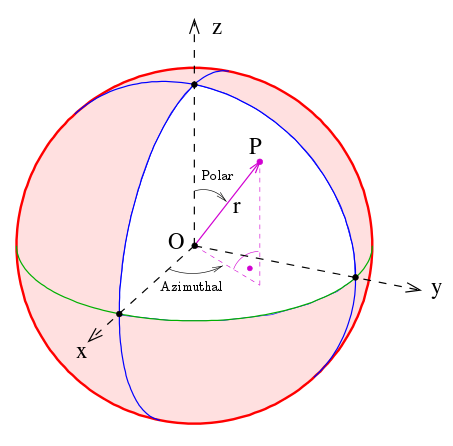
when we plot it in 3d Cartesian space we see:
2. Now the negation of A, that is Earth is not spherical is also true as first if we talk about the nature of a sphere on a three dimensional axial system we can see X,Y and Z are the three axis and with respect to the axes the locus of the sphere will be a function of X,Y and Z. But when we analyze the real locus of earth we come to know that, Earth is bulged at the equatorial part and flattened to the poles. This tells us that Earth is not completely spherical and this is a mere assumption that Earth is a sphere. As we can see statement and negation of statement a both are true, The reason is because the statement A is not a logical statement, it has multiple true or false values negation of A (~A) and A both of the statements are true as well as false at the same time.
Hypothalamically assumed, error and reality
Now the next question arises in the mind, why Earth is not spherical in shape? The answer lies between the three terms called as
1)Hypothetical condition
2)Reality
3)Error
While speaking about hypothetical condition, the condition that can be either mathematically or by physical methods can be predicted/assumed to be true are said to be hypothetical conditions. These conditions are not generally seen in the real world. For example:
The equation given by Albert Einstein ΔE=(c^2)Δm , in this equation as we can see an object of mass m, when approaches the speed of light it starts to get converted into pure form of energy. (although this is now found out to be improper equation.) while dealing with this equation and object physically can’t be thrown with the speed of light, but by using mathematical laws we are just making it approach to the speed of light. This tells us that we can’t do it physically but in mathematical language we can make the object do whatever or however impossible job is physically.
Reality is defined as anything that we can do practically as well as physically which can be either be observable or detectable by our senses and could be understood physically in the nature. For example we can’t technically see or touch energies. But we can produce energy in the form of sound or heat etc full stop we produce sound by using our vocal cords or sense that energy wave be ears. This tells us that we can’t hypothetically show that how energy is produced but we can roughly feel that energy physically (practically) .
Error can be defined as the difference between hypothetical condition and real observation. Real observation and hypothetical condition in nature are always found to contradict with each other and this can be easily explained with the help of error. Error is a quantity that tells us how much distance we have to cover to reach till hypothetical condition.
 Vedic Science